
CHRSD Foundation, Lunera Eye Care & Nevronus Systems Host Free Eye Care Camp for Garment Workers in Tongi
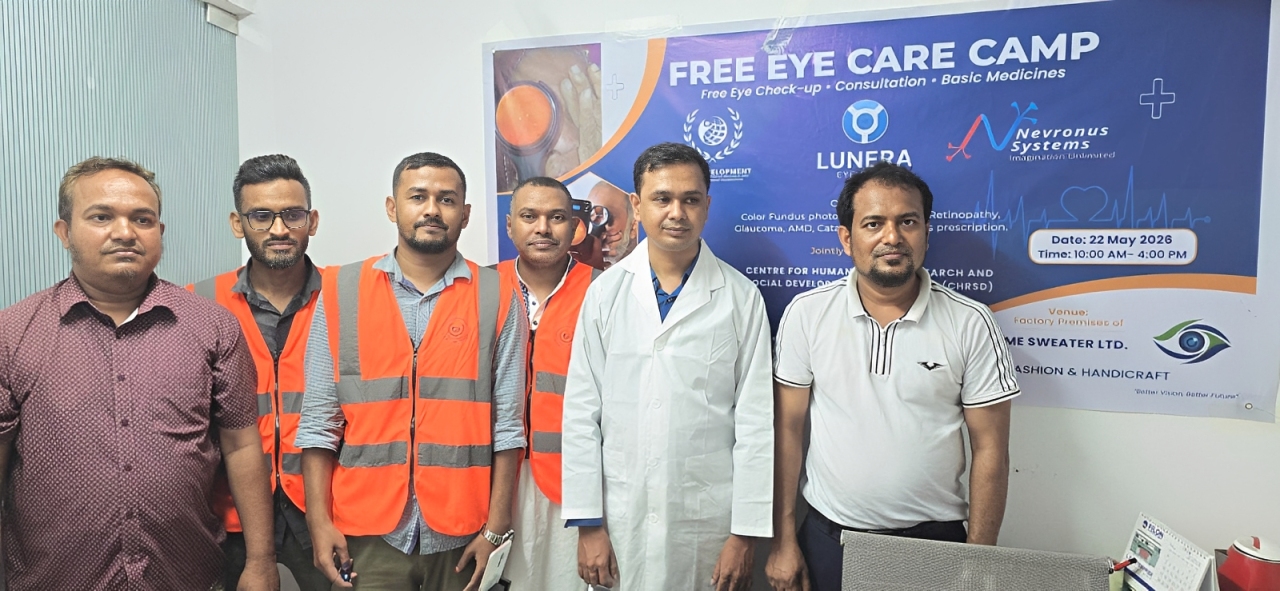
The Centre for Humanitarian Research and Social Development Foundation (CHRSD), in partnership with Lunera Eye Care and Nevronus Systems, successfully organized a free eye screening camp on Friday, 22 May 2026, at Omi Sweaters Limited in Deora, Tongi, Gazipur. The initiative provided accessible, quality eye healthcare to 202 garment workers and local community members, with a focus on early detection of preventable blindness and occupational vision disorders.
AI-Powered Screening for Working-Class Communities
The camp leveraged cutting-edge diagnostic technology to serve a population that typically lacks access to specialized eye care. Lunera Eye Care deployed its advanced handheld color fundus photography machine alongside an Artificial Intelligence (AI)-powered mobile application capable of detecting eye diseases — including diabetic retinopathy, glaucoma, age-related macular degeneration (AMD), cataracts, and refractive errors — within minutes.
"This is not charity. This is what healthcare should look like when technology meets intention," said Mr. Rajib Mustafiz, Patron of Lunera Eye Care and Organizing Secretary of CHRSD Foundation, who attended the inaugural ceremony. "A garment worker shouldn't have to choose between her eyesight and her daily wage."
What the Data Revealed
A systematic clinical review of 202 patient records conducted by CHRSD Foundation reveals significant patterns in occupational eye health:
- Refractive error was the most common condition, affecting 51 patients (25.2%), with a notable male skew (33 male vs. 18 female)
- Dry eye syndrome affected 41 patients (20.3%), more prevalent among female workers — consistent with prolonged exposure to garment factory environments
- 53.9% of patients required spectacle prescriptions, while 3.0% were referred for specialist care
- The patient base was nearly gender-balanced (49.5% male, 50.5% female) and primarily working-age adults (18–44 years comprising 62.4%)
A Hidden Workplace Hazard
Mr. Md Motalib Hossain, Secretary General of CHRSD Foundation, highlighted an often-overlooked occupational health issue affecting the ready-made garment sector: "Many garment workers unknowingly live with color blindness and color recognition deficiencies. In an industry where matching fabric shades and identifying quality defects is daily work, this doesn't just hurt productivity — it compromises workplace safety and worker dignity."
Hossain emphasized that ensuring healthcare for working-class people is not merely corporate social responsibility but a fundamental humanitarian commitment, and revealed that CHRSD is preparing to launch a primary dental care project for school-going children.
Industry Support
Mr. Al Amin, Managing Director of Omi Sweaters Limited, welcomed the initiative and noted that such healthcare activities directly improve workers' quality of life and, by extension, factory performance. Professional eye care services were provided by Mr. Anwar H. Monj, Optometrist of Enam Medical College.
A Call to Factory Owners
At the concluding session, Mr. Md Motalib Hossain issued a direct appeal to Bangladesh's garment industry leadership: "If factory owners step forward to support these humanitarian healthcare initiatives, we can protect thousands of workers from preventable blindness. The technology exists. The need is clear. What remains is the will to act."