
Introduction
On World Environment Day 2026—hosted by the Republic of Azerbaijan under an intensifying global spotlight on the climate crisis—the distance between international policy declarations and on-the-ground impact often feels painfully wide. The United Nations Environment Programme (UNEP) has long reminded us that stabilizing our planet’s temperature requires more than ambitious pledges in distant conference halls. It demands a parallel movement: systemic decarbonization from above, yes, but also rooted, patient ecological restoration from below.
At the Center for Human Rights and Sustainable Development (CHRSD), we believe these two approaches are not alternatives. They are allies.
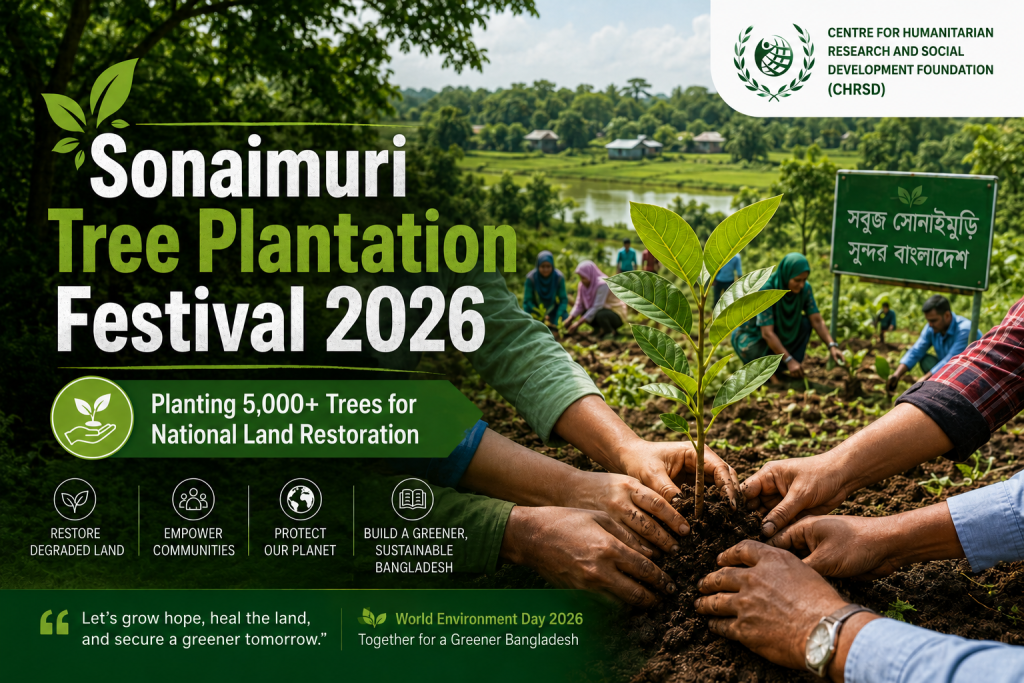
This June 5, we are turning that belief into action. In Sonaimuri Upazila, Bangladesh, we are launching the Sonaimuri Tree Plantation Festival—a single-day, community-driven effort to plant over 5,000 native trees. This is not merely a symbolic gesture. It is a deliberate, strategic intervention designed to serve a much larger purpose: directly supporting the Government of Bangladesh’s national commitment to plant 250 million trees nationwide. In doing so, we aim to demonstrate how localized climate action, when done with rigor and community leadership, becomes the living bridge between national land restoration goals and global environmental justice.
Why Sonaimuri? A Landscape at the Frontline
The choice of Sonaimuri Upazila as the heart of this year’s festival is neither accidental nor merely sentimental. Located in the ecologically sensitive delta region of Bangladesh, Sonaimuri is a landscape where climate vulnerability is not a future prediction—it is a daily reality. Shifting rainfall patterns, rising soil salinity, intensifying extreme weather events, and gradual land degradation have pressed hard against the livelihoods of farming communities here.
From an eco-justice perspective—which lies at the core of CHRSD’s mandate—environmental decline and human rights erosion are not separate crises. They are two faces of the same storm. When forests shrink, soils weaken. When soils weaken, harvests fail. When harvests fail, families go hungry, children leave school, and communities lose the buffer zones that once protected them from floods and cyclones.
Reforestation, then, is not merely an environmental activity. It is a human rights imperative.
By concentrating our 2026 Tree Plantation Festival in Sonaimuri, CHRSD is working to reverse this cycle. We are selecting endemic, climate-resilient species to restore soil health, revive local biodiversity, strengthen carbon capture, and—most critically—rebuild the natural infrastructure that rural families depend upon for survival and dignity.
From Local Soil to National Strategy
Our 5,000 trees in Sonaimuri will not stand alone. They are designed as one small but vital thread in a much larger national tapestry.
The Government of Bangladesh’s commitment to plant 250 million trees represents one of the most ambitious nature-based climate strategies in South Asia. It aligns directly with Bangladesh’s Nationally Determined Contributions (NDCs) under the Paris Agreement and the forward-looking Mujib Climate Prosperity Plan. But national ambitions succeed or fail at the local level. Policies do not plant trees. People do.
This is where CHRSD sees its role clearly. Non-governmental organizations like ours are not substitutes for state action—we are partners and conduits. We translate national targets into neighborhood realities. We turn “250 million trees” from a statistic into a shared, lived endeavor. Every sapling grounded in Sonaimuri is proof that policy can become practice when communities are empowered, equipped, and trusted.
And let us be clear: this is exactly what World Environment Day 2026 asks of us. While global attention rightly turns to the macro-level negotiations happening in Baku, we in Sonaimuri are answering the same emergency with our hands in the soil. Because reforestation is not a single solution—it is a multi-layered strategy that:
- Sequesters carbon at the local level, offsetting emissions that larger climate frameworks struggle to capture.
- Regulates microclimates, cooling rising local temperatures that threaten crop viability.
- Protects biodiversity, restoring fragmented habitats for native birds, insects, and small mammals that keep ecosystems alive.
- Stabilizes livelihoods, offering shade, fruit, timber, and stronger land for the families who tend these trees for generations.
The Deeper Work: Human Rights and Community-Led Ecology
At CHRSD, we have learned one thing through years of grassroots environmental work: no tree survives without a custodian. And no custodian commits without ownership.
That is why the Sonaimuri Tree Plantation Festival is not a top-down planting drive. It is a civic mobilization. We are partnering with local schools, women-led cooperatives, farmer collectives, and youth environmental clubs—not as beneficiaries, but as co-leaders. These are the people who will water these saplings during dry spells, guard them during storms, and watch them grow into the canopy their children will inherit.
Long-term monitoring matters. Sapling survival rates matter. Community stewardship is not a feel-good add-on; it is the only scientifically proven path to reforestation that lasts. Every tree sponsored, every volunteer trained, every local family engaged moves us closer to an ecological restoration that is both sustainable and just.
A Closing Invitation
As we observe World Environment Day 2026, we offer a gentle but urgent reminder to our global partners, fellow civil society organizations, policymakers, and concerned citizens everywhere: the climate fight will not be won solely in conference centers. It will be won in places like Sonaimuri—where vulnerability meets courage, where policy meets practice, and where ordinary people do extraordinary things with simple tools like soil, saplings, and solidarity.
We invite you to join us. Not through distant applause, but through action that mirrors our own.
- Partner with us. Support the Sonaimuri Tree Plantation Festival with funding, technical expertise, or advocacy amplification.
- Learn with us. Study what works in community-led reforestation and adapt these models to your own landscapes.
- Plant with us. If you cannot hold a shovel in Sonaimuri, find the vulnerable ground nearest to you and start there.
The roots we lay down today in this small corner of Bangladesh are not just for Sonaimuri. They are foundations for a climate-secure, ecologically rich, and human rights-centered world. And that world begins with one tree, one community, one determined act of resilience at a time.
Together, we plant the future.
For partnership inquiries, volunteer coordination, or to sponsor a sapling in Sonaimuri, please contact CHRSD directly or visit our website. Let us build resilience—root by root.