
Beyond the Glass:
Why Dairy Is a Matter
of Human Security
Feeding 10 billion people by 2050 is not merely an agricultural challenge — it is the defining test of our generation’s commitment to peace, dignity, and human potential.
In boardrooms and refugee camps alike, food security is increasingly understood as the bedrock of stability. At the Centre for Humanitarian Research and Social Development Foundation (CHRSD), we have spent years studying what happens when that bedrock cracks. What we have found is both sobering and deeply actionable: a single, widely misunderstood food source — dairy — sits at the intersection of nutrition science, economic equity, climate resilience, and human rights.
The Crisis We Are Not Talking About
A World on the Edge of Nutritional Collapse
When we speak of hunger, we tend to conjure stark images: empty bowls, gaunt limbs, acute famine. These are real and demand urgent response. But the deeper crisis — the one that quietly erodes human capital across generations — is what scientists call the “double burden of malnutrition.”
According to the Global Report on Food Crises 2026, released by the Global Network Against Food Crises, the situation is not improving. Acute hunger has not just persisted — it has doubled over the past decade. For the first time since formal famine reporting began, famine was declared in two separate contexts simultaneously in 2025: in areas of Gaza and Sudan.
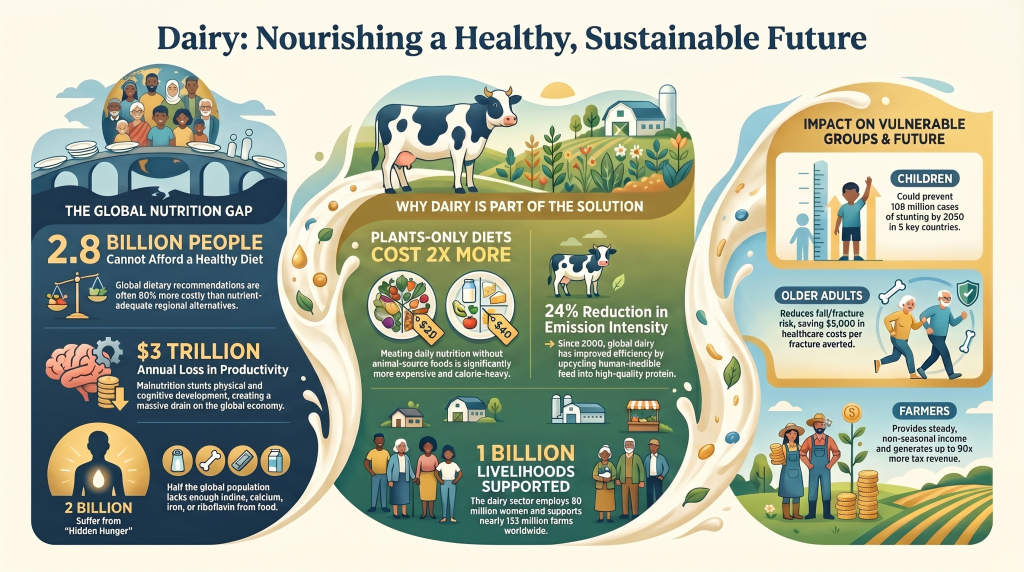
Hidden hunger is the slow violence. A child can consume enough calories and still suffer profound cognitive impairment from iodine, iron, zinc, or vitamin B12 deficiency. A pregnant woman eating daily but lacking calcium and protein will bear children whose life potential is diminished before their first breath. The global economy loses an estimated $3 trillion annually in productivity to malnutrition. That is not a statistic. That is civilisational haemorrhage.
The proportion of acutely food-insecure people analysed is now nearly double the share recorded in 2016. Conflict drove nearly 150 million into acute hunger last year alone. If current trends continue, an estimated 512 million people could face hunger by 2030.
The Economics of Nutrition
The Price Paradox: When “Healthier” Costs More
A powerful and well-intentioned narrative has dominated global nutrition policy: shift the world to plant-based diets and we solve both malnutrition and climate change in a single stroke. The evidence, however, tells a more complicated — and ultimately more human — story.
Data-driven nutritional modelling from Indonesia, the Philippines, Kenya, Tanzania, and across the developed world reveals a stubborn truth: for billions of people, a nutritionally adequate diet that excludes animal source foods is not a choice available to them. It is simply unaffordable.
Plants-Only Diet — The Hidden Costs
- 35–45% more expensive to achieve basic nutrient adequacy globally
- 2 to 11× more expensive in developed nations like the US and New Zealand
- The 2019 EAT-Lancet Planetary Health Diet is 60% costlier than regional alternatives providing the same nutrient adequacy
- Vitamin B12, calcium, heme-iron, and complete amino acids require complex supplementation
- Modelling in Kenya and Tanzania shows animal source foods are essential for lowest-cost adequate diets
Dairy-Inclusive Diet — The Efficiency Case
- Bioavailable calcium, B12, complete protein in a single, low-cost serving
- 3.5 servings of full-fat dairy daily meets critical calcium and protein targets (Australian clinical trial)
- $0.50 USD daily investment yielding $5,000+ in healthcare savings per fracture averted
- Non-seasonal income source — daily milk production vs. annual or biannual crop harvests
- Produces natural fertiliser, reducing synthetic input dependence
We must be clear: this is not an argument against plant-rich diets for those who can access and afford them. It is an argument against imposing a singular dietary philosophy on 2.8 billion people who cannot afford a healthy diet by any measure. Policy that ignores price is policy that will fail the poor.
The $0.50 Revolution
Closing the Health-Span Gap for an Ageing World
By 2050, the population aged 65 and older will more than double. We are living longer — but we are not necessarily living well. The gap between lifespan and health-span is widening, placing unbearable strain on already fragile health systems, particularly in low- and middle-income countries.
A daily investment of just $0.50 USD in full-fat dairy could prevent a fracture that costs over $5,000 to treat — a 10,000× return on nutrition.
A major clinical trial in Australia demonstrated that just 3.5 daily servings of full-fat dairy — milk, cheese, and yogurt — could meaningfully close gaps in calcium and high-quality protein, directly reducing falls and fractures in older adults. The healthcare savings: more than $5,000 per averted fracture. The cost of that prevention: roughly fifty cents a day.
For governments wrestling with spiralling public health expenditures, this is not merely a nutrition recommendation. It is fiscal common sense. Dairy’s unique combination of bioavailable calcium, protein, and phosphorus makes it one of the highest-efficiency tools in preventive medicine — one that can be delivered not through a clinic, but through a corner market.
The Circular Economy of the Farm
Nature’s Premier Upcyclers: Rethinking the Livestock Narrative
The dominant critique of dairy in climate conversations rests on a fundamental mischaracterisation: that livestock compete with humans for food. The data tells a different story entirely — one of biological partnership that our food systems depend upon.
The global dairy herd consumes 2.5 billion tonnes of dry matter annually that is entirely inedible to humans: grass, straw, chaff, bran, and crop residues. Globally, 95% of ruminant feed cannot be eaten by people. Dairy cattle do not take food from human mouths. They transform waste streams into high-quality, bioavailable protein — and return natural fertiliser to the soil, reducing our dependence on synthetic alternatives that carry their own environmental burden.
This is not a defence of all livestock practices everywhere. There are valid concerns about land-use, methane emissions from poorly managed systems, and water use. But the solution is precision and improvement — not elimination. Through climate-smart practices including improved feed efficiency, methane capture, and regenerative grazing, the sector has already reduced farm-gate emissions intensity by 24%. The trajectory is the right one.
The cow is not our competitor. The cow is our most ancient and efficient ally in the project of turning the inedible into the life-sustaining.
M A Ramim, Executive Director — CHRSDCelebrating Women Farmers
One Billion Livelihoods. Eighty Million Women. One Steady Stream of Income.
Statistics about food security risk becoming abstract. Let us make this concrete. The dairy sector supports 1 billion people worldwide — a number so large it is easy to skim past. Behind it are smallholder farmers rising before dawn, women managing herds and households simultaneously, youth who stayed in rural communities because dairy gave them a viable future.
This year’s World Milk Day theme — Celebrating Women Farmers — is not a symbolic gesture. It is a recognition of economic reality. Women constitute 80 million of the dairy sector’s workforce and lead approximately 37 million farms. In many of the world’s most food-insecure regions, these women are the difference between a family that eats adequately and one that does not.
Unlike seasonal crop harvests — which can leave a family income-free for months — dairy provides daily, non-seasonal income. For a mother in a rural community in Bangladesh, Kenya, or the Philippines, this consistent cash flow is the difference between keeping a child in school and pulling them out when the lean season arrives. Multiply that across millions of households, and you begin to understand why dairy is not just a food group. It is a financial instrument for the poor.
“The dairy sector supports the livelihoods of one billion people. From preventing 109 million stunting cases in children to saving billions in healthcare costs by reducing fractures in our ageing population, dairy is a cornerstone of humanitarian development — and of the stable, peaceful societies we are all working toward.”M A Ramim · Executive Director, CHRSD · World Milk Day 2026
A Roadmap to 2050
Evidence-Based Optimism: What We Must Do Now
Urgency without direction is anxiety. At CHRSD, we believe in what we call evidence-based optimism — the conviction that if we build policy on rigorous data rather than ideology, we have every reason to believe we can nourish 10 billion people without destroying the planet that sustains us.
Maintain Dairy as a Distinct Food Group
CHRSD calls on policymakers and dietary guideline bodies worldwide to resist pressure to subsume dairy into generic “protein” or “calcium” categories. Its unique nutrient synergy — bioavailable calcium, complete protein, B12, iodine, and phosphorus in a single, affordable source — demands distinct recognition in national food policy frameworks.
Invest in Smallholder Dairy Productivity
The fastest path to reducing childhood stunting at scale runs through improved dairy access for rural families. Modelling suggests that targeted productivity investments could prevent 109 million stunting cases by 2050. Development finance institutions should treat dairy infrastructure — cold chains, veterinary extension, cooperative formation — as first-tier health investments.
Accelerate Climate-Smart Dairy Practices
The 24% reduction in emissions intensity since 2000 demonstrates what is possible. The “Pathways to Dairy Net Zero” initiative must be scaled, funded, and integrated into national climate commitments. We can reduce dairy’s environmental footprint without reducing its nutritional contribution — but this requires investment, not elimination.
Centre Women Farmers in Policy Design
Gender-responsive dairy policy — from access to credit and land tenure to cooperative leadership — is not ideological aspiration. It is the most efficient lever for improving household nutrition, school attendance, and community resilience across the developing world.
Treat Nutrition as a Security Issue
UN Peacekeepers are deployed to manage the symptoms of instability — conflict, displacement, civil unrest. The conditions that produce that instability are routinely rooted in economic desperation, which is routinely rooted in food insecurity. Diplomats, security analysts, and defence planners should be sitting at the same table as nutritionists and agricultural economists.
Conclusion
Are We Ready to Treat Nourishment With the Urgency It Deserves?
World Milk Day is, at its best, a moment to pause and recognise what is too easily taken for granted — the extraordinary chain of human effort, biological ingenuity, and ecological partnership that puts a glass of milk on a child’s breakfast table each morning.
But for us at CHRSD, it is also a call to action. The data is unambiguous. 266 million people face acute food insecurity today. Two famines were declared last year. Childhood stunting robs 150 million children of their cognitive and physical potential. An ageing global population faces a healthcare crisis that a daily investment of fifty cents could substantially prevent.
The solutions exist. They are affordable. They are scalable. They are already working in communities across Asia, Africa, and Latin America. What is missing is not knowledge. What is missing is the political will to treat the nourishment of the human body with the same gravity we afford the security of our borders.
At CHRSD, we believe these are the same conversation. Metabolic security is human security. And today, on World Milk Day 2026, we renew our commitment to making that case — loudly, evidently, and without apology — in every policy room, every dietary guideline committee, and every development finance boardroom we can reach.
✦ Maintain dairy as a distinct, essential food group in all national dietary guidelines.
✦ Direct development finance toward smallholder dairy productivity in food-insecure regions.
✦ Integrate the “Pathways to Dairy Net Zero” framework into national climate commitments.
✦ Prioritise gender-responsive dairy policy to maximise household nutrition outcomes.
✦ Treat food security as an indispensable pillar of peace, stability, and human development policy.
Join the Conversation
Support CHRSD’s mission to advocate for evidence-based food policy and sustainable peace through nutrition security.
Contact CHRSD · info@chrsd.org