
Dhaka, Bangladesh | 01 Jun 2026
CHRSD Champions Dairy Sector as Key to Solving Global Malnutrition on World Milk Day 2026
DHAKA, June 1, 2026 — On the occasion of World Milk Day, the Centre for Humanitarian Research and Social Development (CHRSD) has released a new policy brief highlighting the indispensable role of the dairy sector in achieving UN Sustainable Development Goal 2: Zero Hunger.
As global food systems face the dual challenges of a growing population and climate change, CHRSD identifies dairy as a “high-impact” sector. Research indicates that dairy products account for more than one-quarter of daily protein requirements and over half of daily calcium needs at a lower retail cost than alternatives.
“The dairy sector supports the livelihoods of one billion people,” says M A Ramim, Executive Director of CHRSD. “From preventing 109 million stunting cases in children to saving billions in healthcare costs by reducing fractures in our aging population, dairy is a cornerstone of humanitarian development”.
The statement also underscores the industry’s commitment to the environment through the “Pathways to Dairy Net Zero” initiative, which has already seen a 24% reduction in emissions intensity. CHRSD calls on policymakers to maintain dairy as a distinct food group in dietary guidelines to ensure global nutrient adequacy.
For more information on CHRSD’s research and advocacy, visit www.chrsd.org
Contact: Press Office, CHRSD Email: info@chrsd.org
Dhaka, Bangladesh | 28 May 2026
CHRSD Calls for Respectful, Rights-Based Maternity Care on National Safe Motherhood Day
Dhaka, Bangladesh | May 28, 2026 — In observance of National Safe Motherhood Day and the International Day of Action for Women’s Health, the Center for Humanitarian Research & Social Development Foundation (CHRSD) has called for stronger investment in respectful maternity care and expanded midwifery services to reduce preventable maternal deaths across Bangladesh.
As part of this year’s awareness campaign, CHRSD displayed banners, posters, and public awareness materials at several key locations in Dhaka, including Motijheel, Dainik Banglar Moor, and areas surrounding the organization’s Head Office. The campaign highlighted this year’s national message:
“Ensure midwives’ presence, reduce maternal deaths.”
Despite Bangladesh’s progress in reducing maternal mortality over the past two decades, major structural challenges remain. Women in underserved communities continue to face barriers to quality maternal healthcare due to poverty, lack of emergency services, overcrowded facilities, and rising medical costs.
CHRSD emphasized that safe motherhood must go beyond clinical survival and include dignity, informed consent, privacy, and equitable treatment for all women.
“Safe motherhood is a basic human right,” a CHRSD representative stated. “No woman should experience neglect, discrimination, or non-consented treatment during one of the most vulnerable moments of her life. Respectful maternity care must become a national healthcare priority.”
The organization also highlighted the increasing risks associated with indirect maternal health complications such as hypertension, diabetes, and anemia, which continue to contribute to preventable maternal deaths.
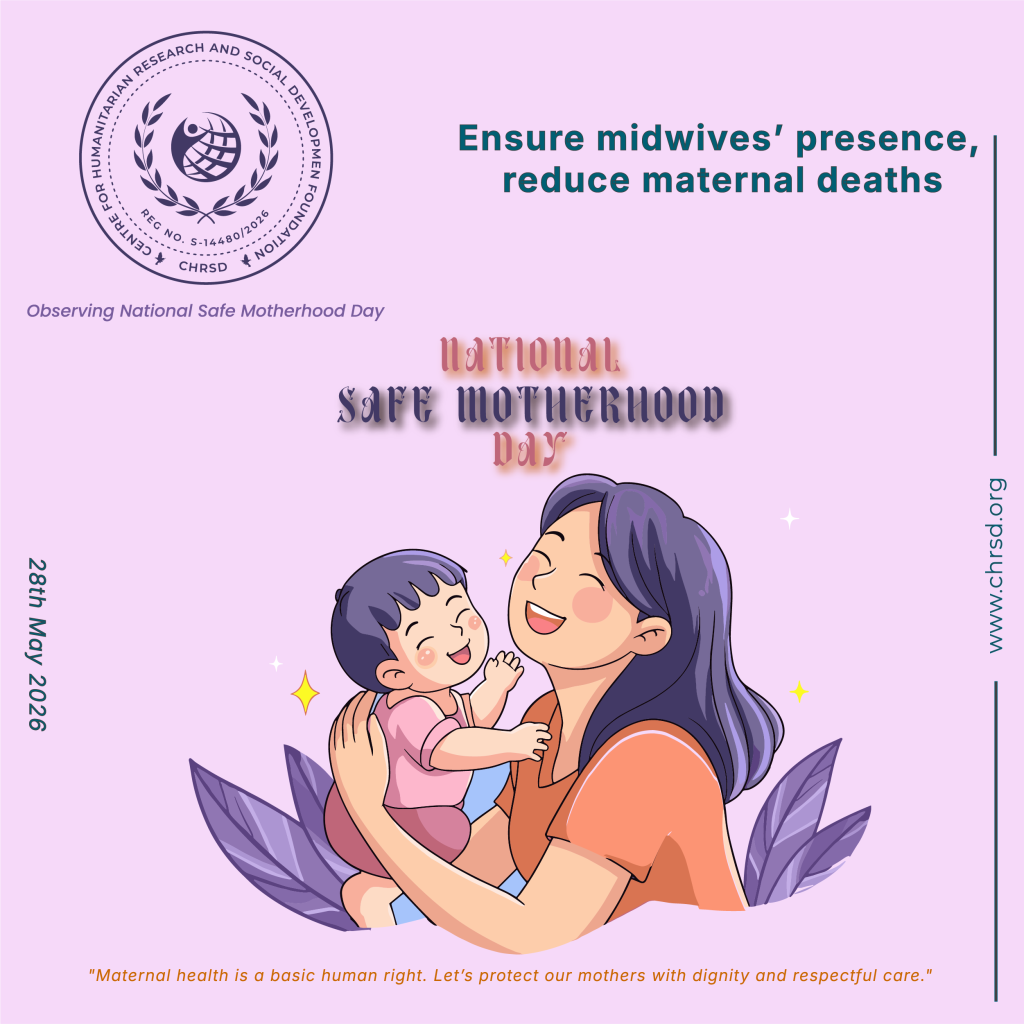
National Safe Motherhood Day, 28th May 2026
To expand public dialogue on the issue, CHRSD is also organizing an international virtual webinar titled:
“A Commitment to Safeguarding the Lives of the Most Vulnerable Women: Reducing Maternal Mortality in South Asia”
The webinar will take place on May 28, 2026, from 8:00 PM to 10:30 PM (Bangladesh Time), bringing together experts, advocates, and stakeholders to discuss sustainable strategies for improving maternal healthcare systems and protecting vulnerable women.
CHRSD urges policymakers, healthcare institutions, development partners, and civil society organizations to work collectively toward ensuring accessible, affordable, and respectful maternity services for every mother across Bangladesh.
Join us LIVE tonight!
| Item | Information |
|---|---|
| Topic | A Commitment to Safeguarding the Lives of the Most Vulnerable Women: Reducing Maternal Mortality in South Asia |
| Date & Time | Thursday, May 28, 2026; 8:00 PM – 10:30 PM (Bangladesh Time) |
| Platform | Virtual |
| Subject | sustainable strategies for improving maternal healthcare systems and protecting vulnerable women. |
| Organized by | Centre for Humanitarian Research and Social Development Foundation (CHRSD) |
📞 How to Participate / Partner With Us
- For individuals: Virtual (Click the link in our bio/comments to register!).
- For community organizations: Contact us to help spread the word for beneficiaries.
- For healthcare partners: We welcome collaboration for future camps.
📧 Email: info@chrsd.org
📞 Phone: +880-1602778984
🌐 Website: https://chrsd.org/
Dhaka, Bangladesh | 24 May 2026
CHRSD Foundation, Lunera Eye Care & Nevronus Systems Host Free Eye Care Camp for Garment Workers in Tongi
Dhaka, Bangladesh | 24 May 2026
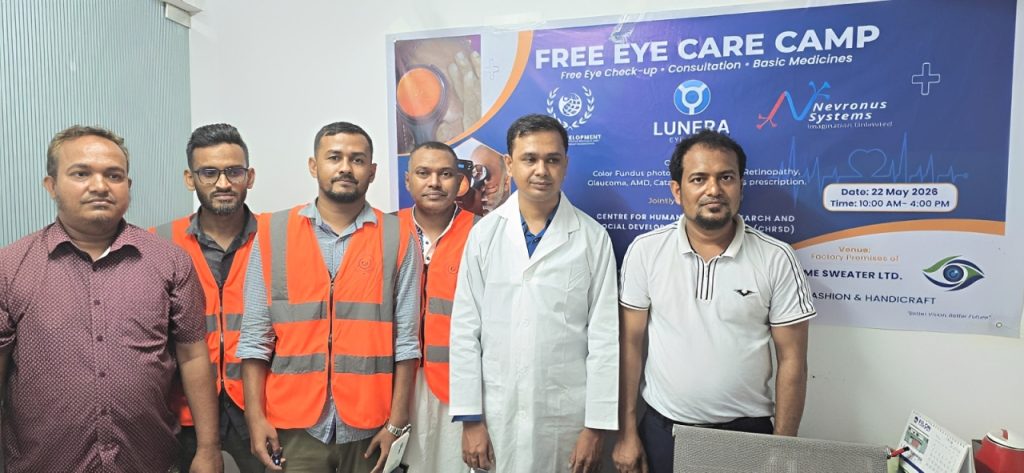
The Centre for Humanitarian Research and Social Development Foundation (CHRSD), in partnership with Lunera Eye Care and Nevronus Systems, successfully organized a free eye screening camp on Friday, 22 May 2026, at Omi Sweaters Limited in Deora, Tongi, Gazipur. The initiative provided accessible, quality eye healthcare to 202 garment workers and local community members, with a focus on early detection of preventable blindness and occupational vision disorders.
AI-Powered Screening for Working-Class Communities
The camp leveraged cutting-edge diagnostic technology to serve a population that typically lacks access to specialized eye care. Lunera Eye Care deployed its advanced handheld color fundus photography machine alongside an Artificial Intelligence (AI)-powered mobile application capable of detecting eye diseases—including diabetic retinopathy, glaucoma, age-related macular degeneration (AMD), cataracts, and refractive errors—within minutes.
“This is not charity. This is what healthcare should look like when technology meets intention,” said Mr. Rajib Mustafiz, Patron of Lunera Eye Care and Organizing Secretary of CHRSD Foundation, who attended the inaugural ceremony. “A garment worker shouldn’t have to choose between her eyesight and her daily wage.”
What the Data Revealed
A systematic clinical review of 202 patient records conducted by CHRSD Foundation reveals significant patterns in occupational eye health:
- Refractive error was the most common condition, affecting 51 patients (25.2%), with a notable male skew (33 male vs. 18 female)
- Dry eye syndrome affected 41 patients (20.3%), more prevalent among female workers—consistent with prolonged exposure to garment factory environments
- 53.9% of patients required spectacle prescriptions, while 3.0% were referred for specialist care
- The patient base was nearly gender-balanced (49.5% male, 50.5% female) and primarily working-age adults (18–44 years comprising 62.4%)
The report also flagged data quality gaps in contact information and standardized medical terminology—areas CHRSD has committed to addressing in future camps to strengthen clinical audit capacity.
A Hidden Workplace Hazard
Mr. Md Motalib Hossain, Secretary General of CHRSD Foundation, highlighted an often-overlooked occupational health issue affecting the ready-made garment sector.
“Many garment workers unknowingly live with color blindness and color recognition deficiencies. In an industry where matching fabric shades and identifying quality defects is daily work, this doesn’t just hurt productivity—it compromises workplace safety and worker dignity,” Hossain stated. “Early detection means these workers can be reassigned to suitable roles rather than silently struggling or being pushed out.”
Hossain emphasized that ensuring healthcare for working-class people is not merely corporate social responsibility but a fundamental humanitarian commitment. He announced plans to expand this healthcare model gradually across Bangladesh and revealed that CHRSD is preparing to launch a primary dental care project for school-going children.
Industry Support
Mr. Al Amin, Managing Director of Omi Sweaters Limited, welcomed the initiative and noted that such healthcare activities directly improve workers’ quality of life and, by extension, factory performance.
Professional eye care services were provided by Mr. Anwar H. Monj, Optometrist of Enam Medical College.
A Call to Factory Owners
At the concluding session, Mr. Md Motalib Hossain issued a direct appeal to Bangladesh’s garment industry leadership: “If factory owners step forward to support these humanitarian healthcare initiatives, we can protect thousands of workers from preventable blindness. The technology exists. The need is clear. What remains is the will to act.”
About the Partners
CHRSD Foundation is an independent, non-political, non-profit organization dedicated to environmental sustainability, evidence-based policy research, and community-centered development across Bangladesh.
Lunera Eye Care specializes in advanced diagnostic ophthalmology, integrating AI-powered screening tools with community outreach programs.
Nevronus Systems provides digital infrastructure and technology solutions for transparent, accountable development programming.
For media inquiries:
Aziz Ahmed
Chief Communications Officer (CCO)
Centre for Humanitarian Research and Social Development Foundation (CHRSD)
media@ chrsd.org | press@ chrsd.org